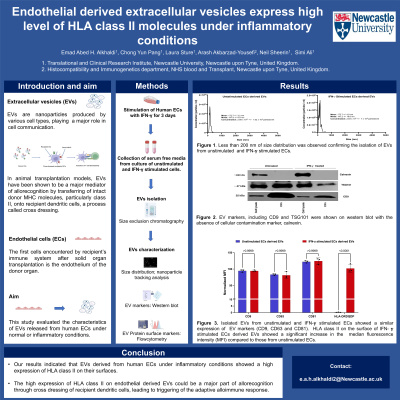
Aim: The first cells encountered by recipient’s immune system after solid organ transplantation is the endothelium of the donor organ. Extracellular vesicles (EVs) are nanoparticles produced by various cell types, that play a significant role in cell communication. In animal transplantation models, EVs have been shown to be a major mediator of allorecognition by transferring of intact donor MHC molecules, particularly class II, onto recipient dendritic cells, a process called cross dressing, leading to induction of an alloimmune T cell response. Given the importance of the endothelium and EVs in triggering the alloimmune response, this study evaluated the characteristics of EVs released from endothelial cells (ECs) under normal or inflammatory conditions.
Method: Human microvascular endothelial cells (n = 3) were treated with IFN-γ for 3 days. For EVs isolation, serum free media was collected from culture of untreated and IFN-γ stimulated cells. Size exclusion chromatography was used for EVs isolation and the size distribution was determined by nanoparticle tracking analysis. EVs-associated markers were analyzed on western blot and flow cytometry was used to evaluate the expression of HLA-DR on ECs and the surface proteome of isolated EVs.
Results: Stimulation of ECs with IFN-γ induced a high expression of HLA-DR and on their surface compared to untreated cells (p < 0.001) (Fig. 1). Isolated EVs had a size distribution less than 200 nm (Fig. 2A and 2B). EV markers, including CD9 and TSG101 were shown on western blot with no calnexin, indicating lack of cellular contamination (Fig. 2C). CD9, CD63, and CD81 were expressed on the surface of isolated EVs from untreated and IFN-γ treated ECs with no significant difference. IFN-γ treated ECs derived EVs showed 100-fold increase in the normalized median fluorescence intensity of HLA class II expression on their surfaces compared to those from untreated cells (Fig. 2D).
Conclusion: It is frequently cited that the expression of HLA class II is increased on activated ECs. Our results indicated that EVs derived from ECs under inflammatory conditions showed a high expression of HLA class II on their surfaces. Therefore, the high expression of HLA class II on endothelial derived EVs could be a major part of allorecognition through cross dressing of recipient dendritic cells, leading to triggering of the adaptive alloimmune response.

.jpeg "Emad Abed Alkhaldi photo")